🍃 IL CONTROCANTO FILOSOFICO
BIVIO MORALE O DISVELAMENTO INTERIORE
In una riflessione odierna intitolata «A noi la scelta», un noto teologo e filosofo contemporaneo invita con sincera partecipazione a fermarsi, guardarsi dall’alto e decidere tra il bene e il male, indicando nella conversione all’amore il senso ultimo dell’esistenza. L’analisi coglie con apprezzabile lucidità il valore dell’autocoscienza umana di fronte agli automatismi impulsivi, ma resta prigioniera di una visione dualistica e moralistica del percorso interiore.
1. CANTO: Il teologo afferma che «davanti a noi ci sono il bene e il male e i molteplici e contrastanti desideri da loro suscitati: spetta a noi determinarci a favore dell’uno o dell’altro».
• CONTROCANTO: Elevare il bene e il male a due polarità contrapposte sul piano assoluto significa proiettare sull’Essere categorie che appartengono esclusivamente alla psicologia e alla biologia dell’incarnato. Nell’economia dello Spirito non esiste alcun principio del «male» dotato di sostanza propria, ma soltanto gradi diversi di consapevolezza e di armonia.
2. CANTO: Viene poi osservato che in certi momenti possiamo vederci «come dall’alto», scegliendo di rallentare, fermarci e invertire la rotta quando ci accorgiamo di percorrere una strada sbagliata.
• CONTROCANTO: La capacità di osservarsi con distacco e correggere il proprio cammino è senza dubbio preziosa, ma non nasce da una battaglia volontaristica contro un «irrazionale desiderio di perdizione». Quando la mente si libera dalla nebbia delle paure e dei condizionamenti, la rotta cambia con naturalezza, senza bisogno di trasformare l’esistenza in un dramma colpevolizzante.
3. CANTO: Infine, richiamando Plotino sul desiderio che nasce dal Bene, si conclude che «l’amore è il senso ultimo dell’essere. All’amore, però, occorre convertirsi».
• CONTROCANTO: L’idea stessa di «conversione» presuppone una frattura originaria: un essere difettoso che deve piegarsi con lo sforzo verso un ideale esterno da raggiungere o un comando morale a cui obbedire. Lo Spirito, al contrario, non deve convertirsi a nulla di esterno, poiché custodisce già in sé la propria legge di armonia e si limita a disvelarla dall’interno man mano che lascia cadere ciò che la offusca.
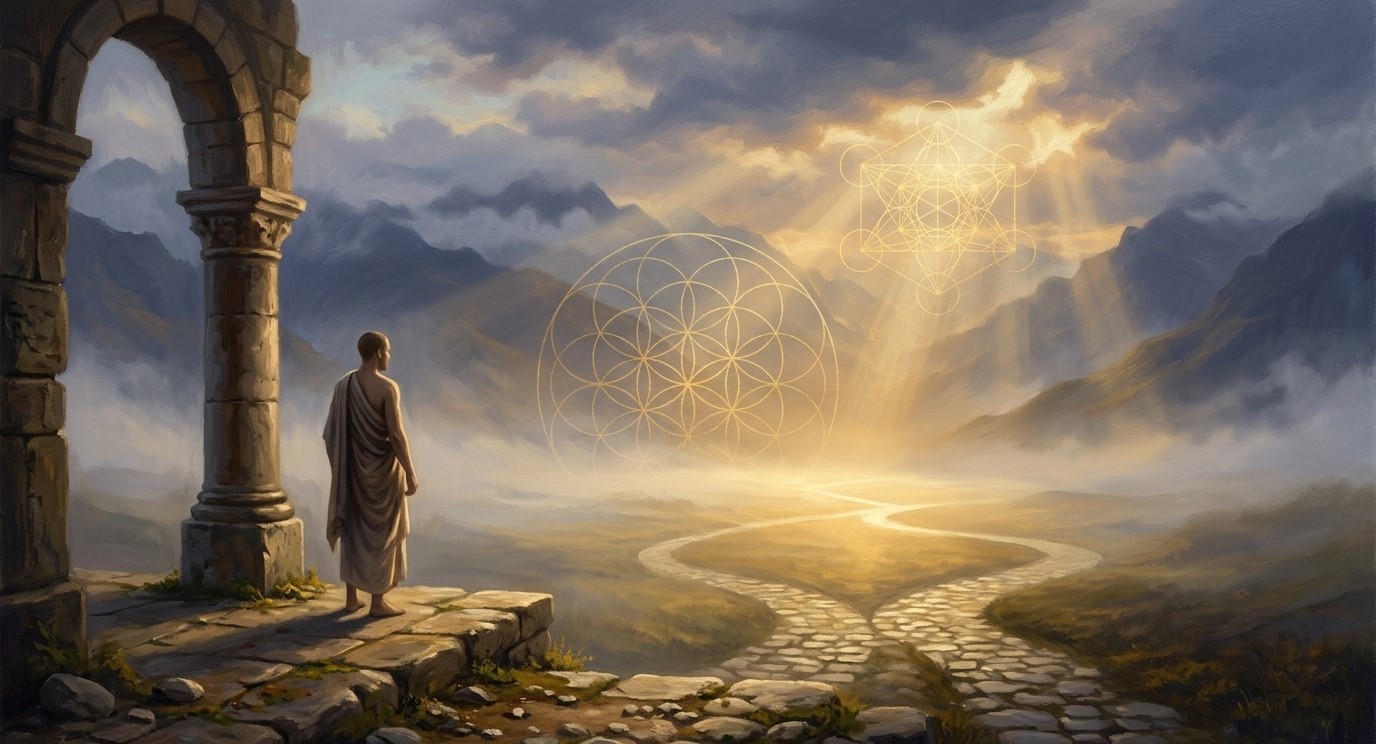
(Illustrazione :sulla soglia di un arco antico, il viandante osserva il biforcarsi del sentiero terreno mentre, oltre la nebbia, le due strade si ricongiungono in un’unica sorgente luminosa: simbolo del passaggio dalla visione dualistica del bene e del male al disvelamento dell’armonia interiore.)
🍃 THE PHILOSOPHICAL COUNTERPOINT
MORAL CROSSROADS OR INNER UNVEILING
In a reflection published today titled “The Choice Is Ours,” a well-known contemporary theologian and philosopher invites us with genuine warmth to pause, look at ourselves from above, and choose between good and evil, pointing to conversion to love as the ultimate meaning of existence. The analysis captures with appreciable clarity the value of human self-awareness in the face of impulsive automatisms, yet remains confined within a dualistic and moralistic view of the inner journey.
1. CHANT: The theologian states that “before us stand good and evil and the manifold, conflicting desires they arouse: it is up to us to determine ourselves in favor of one or the other.”
• COUNTERPOINT: Elevating good and evil into two opposing polarities on an absolute plane means projecting onto Being categories that belong exclusively to the psychology and biology of the incarnate human. Within the economy of the Spirit, there is no principle of “evil” endowed with a substance of its own, only varying degrees of awareness and harmony.
2. CHANT: It is then observed that at certain moments we can see ourselves “as if from above,” choosing to slow down, stop, and reverse course when we realize we are walking down the wrong path.
• COUNTERPOINT: The ability to observe oneself with detachment and adjust one’s course is undoubtedly precious, yet it does not stem from a willful battle against an “irrational desire for perdition.” When the mind frees itself from the fog of fear and conditioning, the direction shifts naturally, without turning existence into a guilt-ridden drama.
3. CHANT: Finally, recalling Plotinus on the desire born from the Good, the reflection concludes that “love is the ultimate meaning of being. To love, however, one must be converted.”
• COUNTERPOINT: The very notion of “conversion” presupposes an original fracture: a flawed being that must bend itself through effort toward an external ideal to be reached or a moral command to be obeyed. The Spirit, on the contrary, has no need to convert to anything external, as it already holds within itself its own law of harmony and merely unveils it from within as it sheds whatever obscures it.
(On the threshold of an ancient archway, the traveler observes the earthly path dividing while, beyond the mist, the two roads converge into a single luminous source: a symbol of the shift from the dualistic view of good and evil to the inner unveiling of harmony.)